|
|
Radiation compromises DNA repair depending on its LET
|
|
It is known that modified nucleobases in DNA by radiaion are recognized
and oxcised by base excision repair proteins known to be glycosylase. We
have measured the enzymatic activities of two proteins from E. colo. (Nth
and Fpg) by treated with DNA irradiated with radiations with various LET
values. The figure below show the data from our publications.
The left side points are the data from γ-irradiation (1), the right side
points from α-irradiation (2). Other points are the data from He ion irradiation
(3) or unpublished data.
|
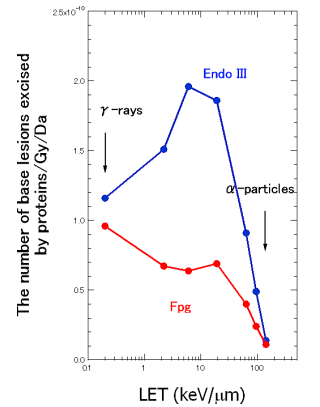
The protein activities are compromised with increasing LET. It has been
clarified that alpha-irradiation causes great loss of the enzymatic activity. The mean free path of alpha
particles from Pu is very short, less than a few micrometers in living material. Thus it could cause much serious DNA damage rather than 137 Cs or 131I. It would be safe if Pu atoms are kept in a closed container because
the vapor pressure of Pr is considerably low.
1)Yokoya, A, Cunniffe, S.M.T. and O’Neill, P., The effect of
hydration on the induction of strand breaks and base lesions in plasmid DNA
films by g-radiation. J. Am. Chem. Soc. 124, 8859-8866
(2002).
2)Yokoya, A, Cunniffe, S.M.T., Stevens, D, O’Neill, P., Induction of
Strand Breaks and Base Lesions in Hydrated
Plasmid DNA Films by a-radiation. J. Phys. Chem. B. 107, 832-837
(2003).
3)Urushibara, A., Shikazono, N., O'Neill, P., Fujii, K., Wada, S.
and Yokoya, A. LET dependence of the yield of single-, double-strand breaks and
base lesions in fully hydrated plasmid DNA films by 4He2+ ion irradiation.
Int. J. Radiat. Biol. 84, 23-33 (2008).
|
|
|
|


